The Ghost Publisher Analytics Stack in 2026


If you publish on Ghost in 2026, analytics got less confusing and more important at the same time.
Less confusing, because Ghost now ships native analytics for traffic, newsletters, and membership growth.
More important, because “I can see the numbers” is not the same as “I know what to improve next.”
This post is a practical stack guide for Ghost publishers: what to use, what to skip, and how to combine tools without drowning in dashboards.
🧭 The three jobs analytics should do
Most Ghost sites need three jobs done well:
- Membership pulse: Are subscribers and revenue healthy?
- Traffic truth: Where are readers coming from, and which posts get attention?
- Growth ops: What should I fix or publish next to grow faster?
One tool rarely owns all three.
That’s the key shift in 2026.
🧩 Layer 1: Ghost Analytics (keep this)
Start with Ghost Analytics inside Ghost Admin.
It’s the best place for:
- Unique visitors and views
- Top content and sources
- Newsletter opens and clicks
- Free vs paid member context
- MRR and post-level growth attribution
Why keep it? Because Ghost already knows your members. Third-party tools can approximate traffic, but they can’t match that membership context as cleanly.
On Ghost(Pro), this layer is basically free and first-party. On self-hosted Ghost, native web analytics needs Tinybird setup.
Use Ghost Analytics for the daily/weekly membership check.
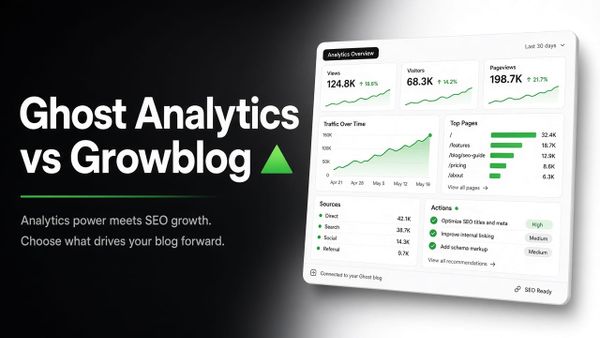
If you want a deeper comparison of where native stops, read Ghost Analytics vs Growblog.
🌱 Layer 2: Growblog (add this when you want growth, not just charts)
Growblog is the Ghost-specific growth layer.
Add it when you care about:
- SEO hygiene inside your posts (meta, slugs, alt text, featured images)
- Broken links and broken images
- Scroll depth and on-site clicks
- Post, tag, and author performance shaped for Ghost content
- A prioritized Actions queue for “what to fix this week”
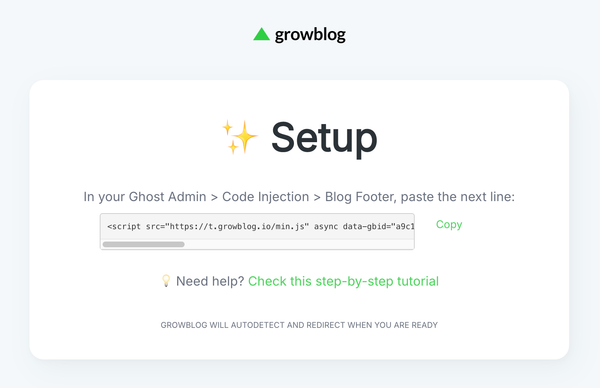
Growblog is cookie-free, installs with one Code Injection line, and works with Ghost(Pro) and self-hosted Ghost.
Think of it like this:
Ghost Analytics tells you if the publication is healthy. Growblog tells you what to repair and double down on.
⚖️ Layer 3: optional privacy analytics (only if you still need it)
Tools like Plausible, Fathom, or Umami are excellent general website analytics.
In 2026, they’re optional for many Ghost publishers, not mandatory.
Keep one if:
- You manage multiple non-Ghost sites in one place
- Your team already reports in that tool
- You want a second opinion on traffic trends
Skip adding yet another privacy tool if Ghost Analytics + Growblog already answer your questions. Extra scripts rarely create extra clarity.
If you’re coming from Plausible specifically, this guide helps: How to Migrate from Plausible to Ghostboard (same product, now Growblog).
❌ What most Ghost publishers can drop
You can usually drop:
- GA4, unless you run ads or need enterprise marketing reporting
- Four overlapping trackers “just in case”
- Manual SEO spreadsheets you never open
- One-off broken-link crawls you forget to repeat
Complexity feels productive. Consistency grows blogs.
📊 Recommended stacks by publisher type
Publisher type | Recommended stack | Why |
|---|---|---|
New Ghost blog | Ghost Analytics only | Keep setup light until traffic exists |
Solo creator with SEO goals | Ghost Analytics + Growblog | Membership pulse + weekly growth ops |
Paid newsletter / membership | Ghost Analytics + Growblog | Revenue context + content/SEO repairs |
Multi-author publication | Ghost Analytics + Growblog (Authors report) | See who actually grows audience |
Self-hosted without Tinybird | Growblog (+ Ghost member stats) | Fast traffic/growth insights without Tinybird pain |
Agency managing many sites | Ghost Analytics + Growblog, maybe Plausible for non-Ghost properties | Separate Ghost growth from generic web stats |
🗓️ A simple operating rhythm
Don’t check everything every day.
Daily (2 minutes)
Ghost Analytics: members, top posts, anything unusual.
Weekly (15-30 minutes)
Growblog Actions: one high-impact fix + a few SEO basics on pages with traffic.
Monthly (30-45 minutes)
Review topics/authors that grew. Plan the next content batch around demand you already proved.
If you want the weekly process spelled out, use the next playbook in this series: the 30-minute Ghost growth workflow with Actions.
❓ FAQ
Is Ghost Analytics enough by itself in 2026?
For early membership monitoring, yes. For SEO audits, broken links, scroll/click behavior, and a prioritized fix list, no.
Should I replace Ghost Analytics with Growblog?
Usually no. Keep Ghost for members/newsletters/revenue. Add Growblog for growth execution.
Do I still need Google Analytics?
Only if you have a clear use case (ads, complex marketing attribution, stakeholder reporting). Most indie Ghost publishers don’t.
What’s the lightest high-performing stack?
Ghost Analytics + Growblog. Two layers, clear jobs, no dashboard sprawl.
❤️ Final thoughts
The winning Ghost analytics stack in 2026 is boring in the best way:
- One place for membership truth
- One place for weekly growth work
- Almost nothing else
If your current setup needs a map to explain, it’s probably too heavy.
Start with Ghost. Add Growblog when you’re ready to turn insights into a habit.
Grow your Ghost blog audience faster 🚀
Start your free trial now and explore all Growblog features for free. No credit card is required.